
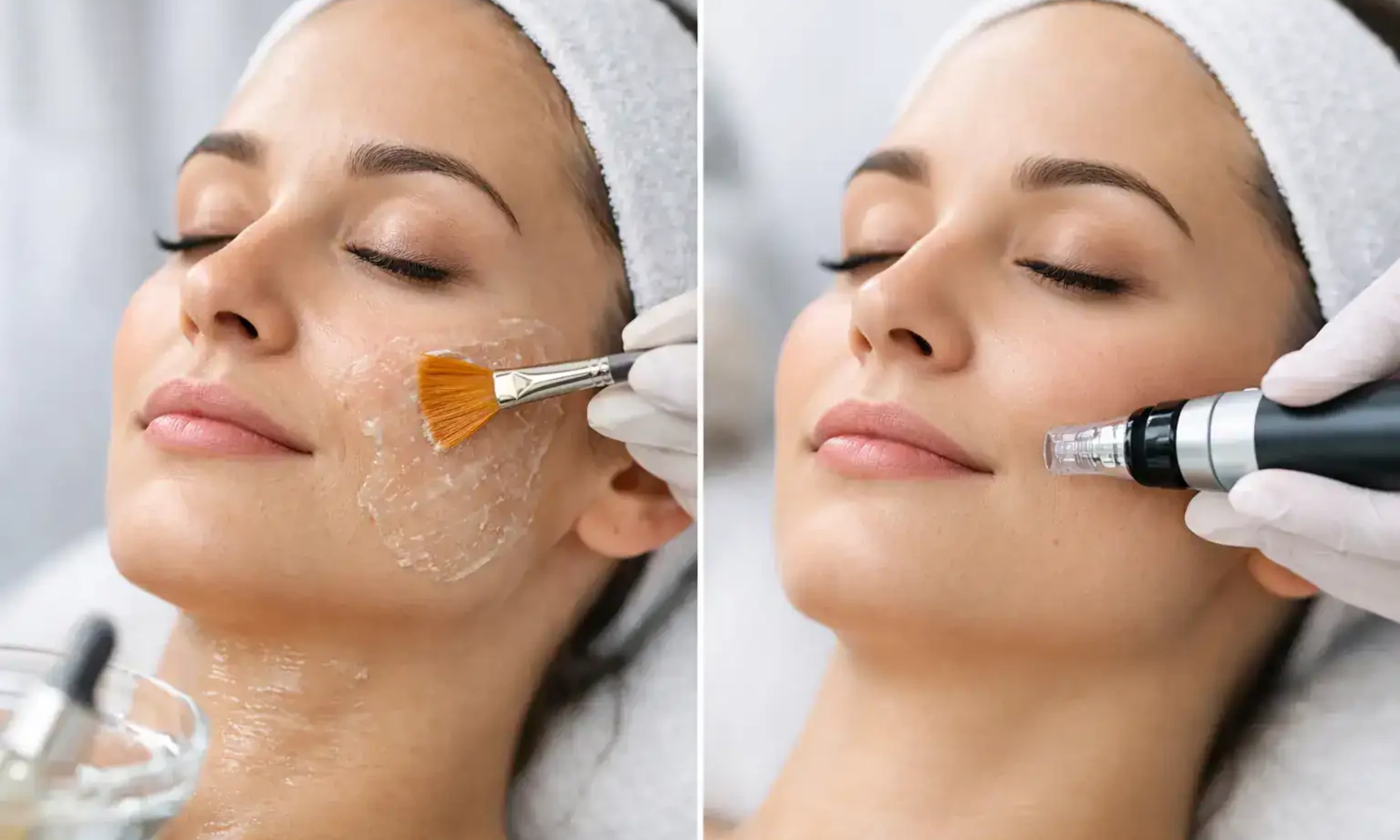
The two treatments come up together so often that most people assume they do the same thing. A friend had a chemical peel before her sister’s wedding and her skin looked noticeably brighter within days. Someone else you know swears by microneedling for the scarring she’s carried since her twenties. Both of them are right. Both treatments work. They just work on different things.
If you’ve been trying to decide between microneedling and a chemical peel, and every comparison article you’ve read has left you roughly where you started, this post is for you. The clinicians at Treeline Aesthetics, serving patients across Lincolnshire and the East Midlands, see this question come up at consultation regularly. The answer is almost never “one is better than the other.” It’s nearly always “it depends on your skin.”
Treeline’s treatments are delivered by GDC-registered clinicians with advanced aesthetics training. That clinical background matters when you’re choosing between two treatments that both have real results but achieve them through completely different mechanisms.
What Is Microneedling And What Does It Actually Do
Microneedling, sometimes called collagen induction therapy, uses a device with fine needles to create tiny controlled punctures across the surface of the skin. The skin reads these micro-injuries as damage and responds by producing collagen and elastin to repair them.
The result builds gradually. You won’t see a dramatic change the morning after treatment. What most patients notice over the following four to eight weeks is that the skin feels firmer, scars look less defined, and overall texture becomes smoother in a way that’s hard to pinpoint but easy to see in photographs.
It’s particularly well suited to atrophic scarring (the pitted, depressed kind left behind by acne), general skin laxity and uneven texture. For patients in Nottingham and Lincoln who’ve spent years covering certain areas with makeup, microneedling is often the treatment that starts to give them a reason not to.
You can find the full details of what the treatment involves, what to expect and how many sessions are typically recommended on the microneedling treatment page.
What is the difference between microneedling and a chemical peel at Treeline Aesthetics?
Microneedling uses fine needles to create micro-channels in the skin, stimulating collagen production and improving texture over several weeks. Chemical peels use an acid solution to exfoliate the skin’s surface, addressing pigmentation, congestion, and dullness with more immediate visible results. Microneedling is generally better for scarring and deeper skin concerns; peels are excellent for surface radiance and evenness.
What Is Chemical Peel And Who Is It For?
A chemical peel uses an acid solution, typically lactic, glycolic, salicylic or trichloroacetic acid depending on the depth required, to remove the outermost layers of the skin. As those layers shed, fresher skin underneath is revealed.
The effect on the right skin type can be quick and visible. A patient who comes in with dull, congested skin and uneven tone often notices a real difference within a week of the skin finishing its shedding process. Peels are particularly effective for surface pigmentation, sun damage, post-inflammatory dark marks and general skin dullness.
They also work well as a seasonal reset. Many patients across Sleaford and the surrounding area book a peel in the autumn after summer sun exposure, or in early spring when skin has been through a long winter looking a bit flat and tired.
The depth of the peel matters. Superficial peels have minimal downtime and are suitable for regular maintenance. Deeper peels achieve more significant results but require a longer recovery window. Your Treeline clinician will advise on the appropriate strength based on your skin type, any sensitivity and your lifestyle, because a peel that requires several days of peeling skin is worth planning around.
Find out more about what’s available on the chemical peels treatment page.
Microneedling Vs Chemical Peel: Which One Suits Your Skin?
For scarring
If the main concern is acne scarring, specifically the depressed, pitted type, microneedling tends to be the stronger choice. The collagen stimulation it triggers works from below, gradually filling and smoothing the scar tissue over a course of treatments. Chemical peels can help with the dark marks that often linger around scars, but they don’t address the texture beneath in the same way.
For pigmentation and uneven tone
Here, chemical peels generally have the edge. By removing the outer layer of skin where excess melanin tends to sit, peels can reduce the appearance of sun spots, melasma and post-inflammatory hyperpigmentation more directly. A well-chosen peel for pigmentation concerns can produce results that feel more immediate than the gradual build of microneedling.
For fine lines and early skin laxity
Both treatments contribute to improvement here, through different routes. Microneedling drives collagen production directly. Peels promote cell turnover and surface renewal. Some patients benefit from both over time, used in a planned sequence rather than simultaneously.
For general dullness and congestion
A chemical peel tends to be the faster route to brighter, cleaner-looking skin. If the concern is that your skin looks flat and congested rather than scarred or lined, a well-selected peel often delivers a visible lift in radiance that microneedling, with its more gradual mechanism, takes longer to match.
Which is better for acne scarring: microneedling or a chemical peel at Treeline?
Microneedling is generally more effective for atrophic acne scars; the depressed, pitted type because it stimulates collagen to fill from below. Chemical peels are better for post-inflammatory hyperpigmentation, the dark marks that often remain after acne. For significant scarring, a course of microneedling is usually the stronger option.
What About Combining The Two?
This is where it gets interesting for patients with multiple concerns, and it’s a conversation worth having at consultation rather than trying to figure out alone.
The two treatments can work well together, but not in the same session and not without a considered plan. Doing both at once would compromise the skin’s barrier and likely extend recovery time without adding benefit. Sequenced correctly, though, a course of peels followed by microneedling, or the reverse depending on the primary concern, can address surface-level pigmentation and deeper texture in a way that neither treatment achieves alone.
For patients considering a broader skin treatment plan, the mesotherapy treatment page covers additional options that can sit alongside both of these within a longer-term skin health programme.
Can I combine microneedling and a chemical peel at Treeline Aesthetics?
Yes, though not in the same session. Many patients benefit from a sequenced approach, perhaps a peel to address surface concerns followed by microneedling to work deeper. Your Treeline clinician will assess your skin and build a treatment plan that sequences these correctly for maximum benefit and minimal recovery overlap.
What To Expect At Your Treeline Consultaion
Neither treatment should be chosen based on a quiz or a comparison article, including this one. The skin varies too much from person to person for a general guide to make the call.
What consultation at Treeline does is give you a proper skin assessment, a clinician who will look at your specific concerns and history, and a recommendation grounded in what the evidence suggests for your skin type. If one treatment clearly suits you better, they’ll say so. If a sequenced plan makes more sense, that will be explained clearly and without pressure.
Treeline sees patients from across Lincolnshire and the East Midlands, including Lincoln, Nottingham and Sleaford, and the same standard of assessment applies regardless of which location you visit.
If you’ve been going back and forth between these two treatments and you’d like a straight answer for your skin specifically, a consultation with the Treeline team is the most useful next step. Book through the Treeline Aesthetics website and bring your questions. The conversation is honest, the assessment is thorough, and you’ll leave knowing what actually suits your skin rather than what sounds good on paper.